
Evidence where it matters mostEffective advocacy needs solid evidence.
We turn research into action for animals.
Many animal advocacy efforts fall short because critical decisions are made without locally relevant evidence. We work with advocacy organizations to answer the questions they face and support them in turning findings into action where the stakes are highest and the issues most neglected.
Neglected contexts
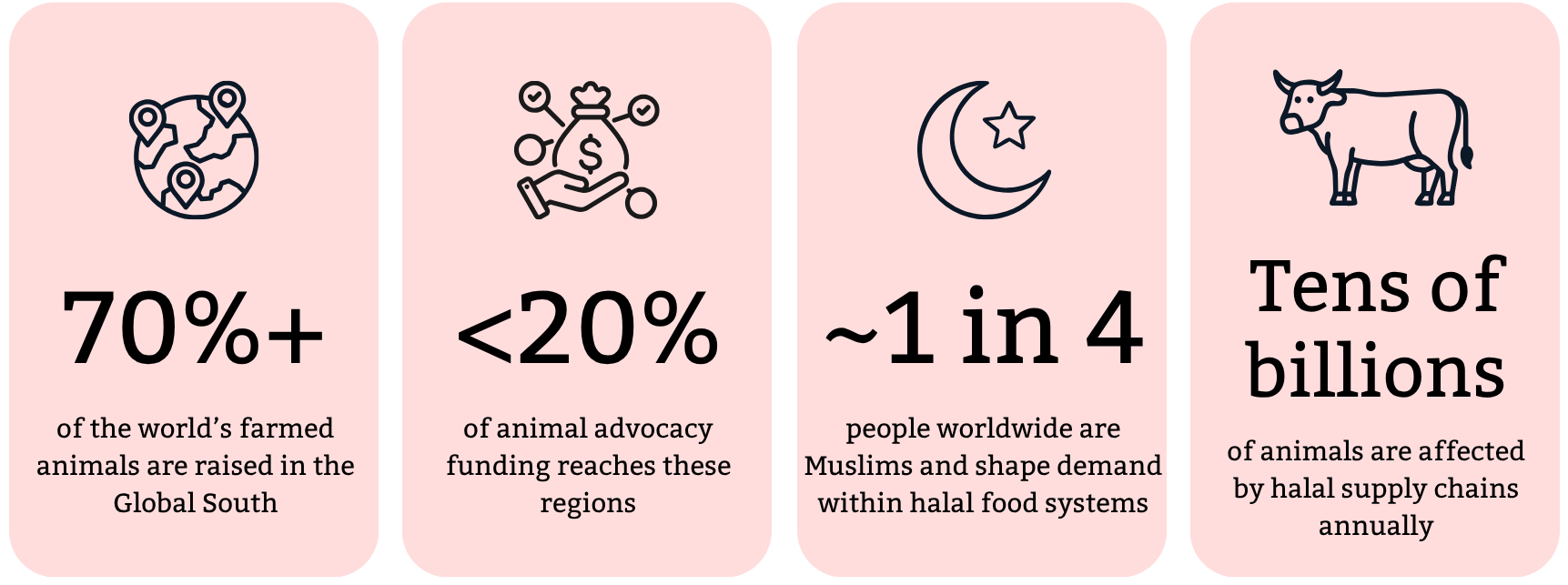
We focus on under-researched regions, especially the Global South and Muslim-majority contexts, where most farmed animals live but locally relevant evidence remains scarce.
Policy pathways
Within these contexts, we prioritize projects with a clear pathway to policy or institutional change, where culturally grounded research can inform regulation, institutional practice, or public engagement.
Demand-driven research
Our research agenda is shaped by our partners' needs. We use applied methods from economics and econometrics to produce evidence that advocates can act on.
From evidence to implementation
We work with advocates to identify specific gaps in evidence that limit their campaigns or institutional engagement. We co-design research around these needs, then help partners apply the findings through tailored briefs, messaging recommendations, workshops, and direct support.
The scale. The gap. The opportunity.
Gülbike Mirzaoğlu, PhD
Co-founder
Gülbike is an economist with a specialization in the economics of crime, social contagion, spatial econometrics, and experimental economics. She also gives lectures on animal rights/welfare, environmental issues, and veganism in collaboration with the Middle East Vegan Society. Since 2023, she has given 25+ talks/workshops across Egypt, Turkey, Rwanda, Uganda, Mozambique, Sri Lanka, Philippines, and El Salvador. Additionally, she works as part-time lead assessor for software projects (ASPICE-ISO/IEC 15504).

Who are we?

Fatma Sueda Evirgen, PhD
Co-founder
Sueda is an economist and Postdoctoral Researcher at the WZB Berlin Social Science Center, specializing in experimental and behavioral economics, prosocial behavior, and inequality. Her academic research focuses on ethnicity-based discrimination, interventions to promote prosocial and sustainable behavior, as well as philanthropic giving and fundraising strategies. She has extensive experience designing and conducting large-scale survey and experimental studies, and applies these methods to questions in animal advocacy.

Tracy Moore
Grant and Fundraising Coordinator
Tracy is a development professional with experience supporting research nonprofits, capacity-building organizations, and sanctuaries. Through her work, she builds meaningful connections between funders and the causes they care about, helping translate their values into lasting impact. She is committed to advancing solutions that reduce animal suffering for a more compassionate future for all.

Sophie Weiner
Creative Design & Communications
Sophie is a global health and development professional with nearly a decade of digital communications and knowledge management experience. She is passionate about advancing sustainable, equitable food systems and is committed to leveraging her background in public health to promote plant-based solutions that benefit people, animals, and the planet.

Research spotlight
How Do Muslim Consumers View Halal and Animal Welfare and Respond to Different Messages?
In collaboration with Kaleem Ahmid, we surveyed 6,294 Muslim consumers across 15 countries—the first study of this scale to examine how halal, animal welfare, and food choices intersect.
Why this matters? Muslim consumers account for roughly one-quarter of the world's population and are a major force in the global food system. Yet little is known about how they connect halal, which defines what is permitted under Islam, and animal welfare, which farming practices they find unacceptable, or which messages—from Islamic framing to animal welfare and environmental arguments—are most likely to resonate.
Without this evidence, advocacy efforts risk overlooking concerns that Muslim consumers already see as relevant to halal or relying on approaches that do not fit their values and priorities.
We developed the study in consultation with 16 organizations and advocates working across animal advocacy, food systems, and Muslim community contexts, whose input helped ensure that it addressed the questions most relevant to their work.
Have questions, feedback, or need help applying the findings? Take this 2-minute feedback survey here. We offer support with understanding the results, adapting them to your context, and identifying relevant next steps.
What they say about us:
-
"Animetrics' focus on economics and neglected regions fills such an important gap in animal advocacy research. Their work is invaluable, and we've partnered with them to bring their unique perspective and skill sets into our own projects, making our research even stronger."
- FAUNALYTICS, Brooke Haggerty, Executive Director,
-
"Their workshop on research and survey design was both comprehensive and easy to follow, thanks to the clear, locally relevant examples, especially in the context from the Philippines."
- ANIMAL ADVOCATE FROM THE PHILIPPINES
-
"We need this kind of input at the current stage of our movement. It was very helpful for devising new tactics."
- GULAY NA! PHILIPPINES
-
"Working with Animetrics has helped us shape our strategy as an organization concentrating in a neglected area of the world with very little information or experience on animal rights or welfare advocacy."
- MIDDLE EAST VEGAN SOCIETY
-
"Use of interventions driven by insightful evidence and data within the African set up is critical in shaping the focus for animal advocacy. Resources and tools provided by Animetrics are key and crucial."New List Item
— AFRICA NETWORK FOR ANIMAL WELFARE, Dennis Bahati, Campaigner and Researcher
-
“Gülbike's workshop was one of the most accessible, condense and informative overviews of everything one needs to know to get started with research in advocacy that I have ever seen. I strongly recommend it to any organization looking to base their work on better evidence”
-HIVE, Kevin Xia, Community Builder,
Past & current partners


